Atradius Atrium
直接访问您的保单信息、信用额度申请工具和洞察力。

 中国
中国
 阿联酋
阿联酋
 爱尔兰
爱尔兰
 奥地利
奥地利
 澳大利亚
澳大利亚
 巴西
巴西
 保加利亚
保加利亚
 比利时
比利时
 波兰
波兰
 丹麦
丹麦
 德国
德国
 法国
法国
 芬兰
芬兰
 荷兰
荷兰
 集团
集团
 加拿大
加拿大
 捷克共和国
捷克共和国
 立陶宛
立陶宛
 罗马尼亚
罗马尼亚
 美国
美国
 墨西哥
墨西哥
 挪威
挪威
 葡萄牙
葡萄牙
 日本
日本
 瑞典
瑞典
 瑞士
瑞士
 斯洛伐克
斯洛伐克
 斯洛文尼亚
斯洛文尼亚
 土耳其
土耳其
 西班牙
西班牙
 希腊
希腊
 香港SAR
香港SAR
 新加坡
新加坡
 新西兰
新西兰
 匈牙利
匈牙利
 意大利
意大利
 印度
印度
 英国
中国
英国
中国

Vietnam’s economy continues to expand at a robust pace, although momentum is easing as weaker external demand restrains exports. Domestic demand remains supportive, but rising inflation is eroding purchasing power and compressing corporate margins. As a trade-dependent economy, Vietnam remains highly exposed to global policy shifts.
Against this backdrop, Vietnamese firms conduct around 45% of business-to-business (B2B) sales on credit, above the regional benchmark. The rest is paid upfront. Vietnamese firms rank among the most active in Asia, second only to Singapore and India. This trend is most evident among large industrial and construction firms, where credit remains a key competitive lever. In the market, firms reporting increased use of trade credit significantly outnumber those reporting a decline, pointing to continued expansion of credit-based trade despite a more uncertain environment.
Vietnam stands out for offering the most lenient payment timelines in B2B trade across the region. Terms of up to one month from invoicing are less common than across Asia, while terms of up to two months remain broadly aligned with the region. Longer terms of up to three months are used by more than twice as many Vietnamese firms, confirming a stronger reliance on extended credit terms. While this supports business relationships, it also increases exposure to payment delays and working capital pressure. Trend data shows that firms reporting the provision of longer payment terms to business customers significantly outnumber the regional share, while far fewer report either no change or shorter terms.
The corporate payment environment has shifted markedly in Vietnam in recent months. Far more firms than across Asia report faster customer payments, setting Vietnam apart from more stable regional trends. However, delayed payments are still reported more frequently than across the region, and overdue receivables remain slightly above the regional average, particularly among SMEs in manufacturing. This highlights a mixed scenario, where longer terms support payment performance for some firms, while others continue to face delays.
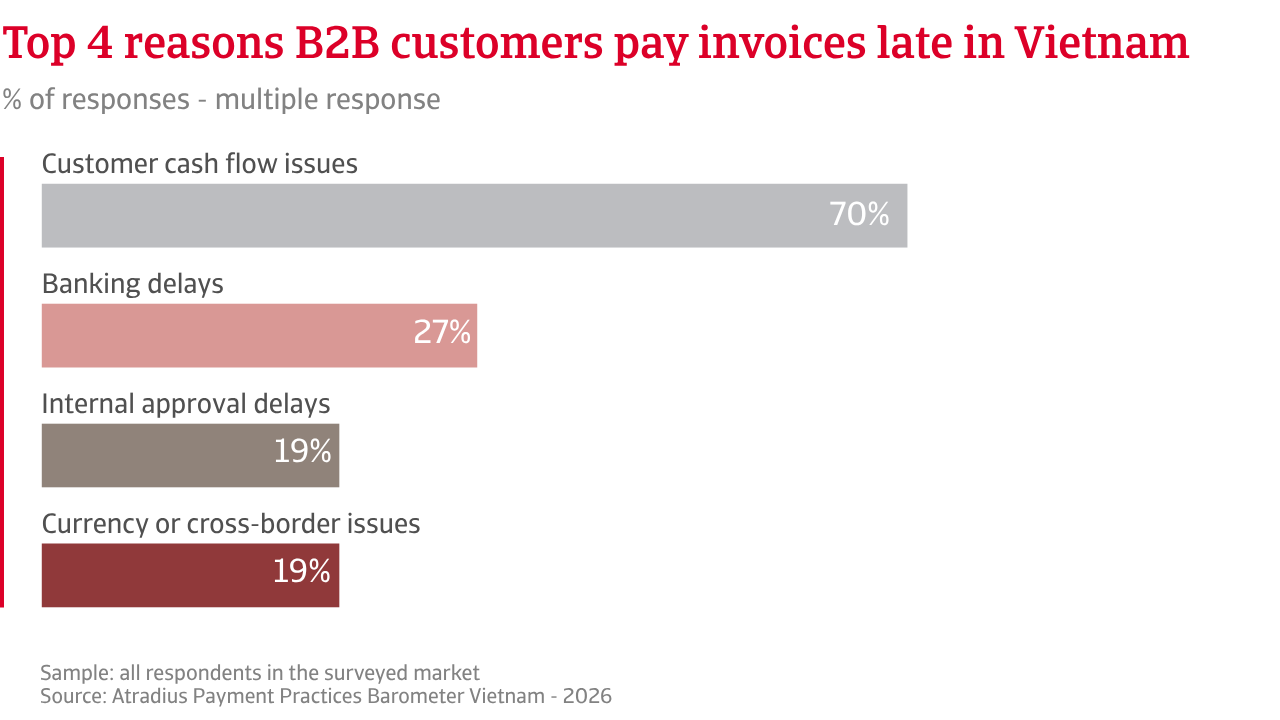
Customer cash flow constraints are a key driver of delays. Vietnamese firms report these far more often than the regional average, underlining ongoing liquidity issues across the market. At the same time, regulatory and compliance factors, as well as banking and cross-border frictions, are more often cited as causes of delay.
Taken together, these features point to a payment environment where longer terms provide firms with greater flexibility to manage liquidity and meet obligations, often within terms or with only short delays. This helps explain the higher share of firms reporting faster payments. However, DSO data shows that payments are collected over longer timeframes, increasing the exposure period during which liquidity pressures can affect customers’ ability to pay. As a result, the likelihood of payments becoming long overdue, and consequently resulting in credit losses, is high. Fewer firms in Vietnam report losses affecting up to 2% of receivables, with far more reporting higher shares.
The impact on working capital is both more pronounced and more widespread than across Asia. Far more companies in the market report increased reliance on external financing, greater difficulty in cash flow planning, and reduced financial flexibility. Nearly half also report constraints on investment in growth or innovation.
Vietnamese firms take a more hands-on approach to managing payment risk than Asian peers do on average. They rely more on credit management, set aside reserves, and use credit insurance more often than their regional peers. They also make greater use of practical tools such as early payment incentives and secured terms. Legal action is used far more often in Vietnam than across Asia. At the same time, fewer firms shorten payment terms, showing that they prefer to manage risk within longer credit periods rather than tighten conditions upfront.
Vietnamese firms conduct around 45% of B2B sales on credit, above the regional benchmark. The rest is paid upfront.

Survey findings show that expectations for B2B payment behaviour in Vietnam are far more positive than across Asia, where views are more balanced. This optimism reflects recent improvements in how customers pay, along with the widespread use of longer payment terms that give them more breathing space. However, this optimism may be too strong, as many firms still face cash flow pressure and longer payment cycles.
While Vietnamese businesses are highly optimistic about further improvements in B2B payment behaviour in the coming months, they also anticipate insolvencies remaining high or increasing in the short-term. While Asia shows consistency between payment and insolvency expectations, this gap suggests that potential improvements in the payment behaviour of business customers in Vietnam are not seen as the result of stronger financial health, but rather as the consequence of longer payment terms and active credit management. While these measures help sustain payment flows in the short term, they do not eliminate the widespread financial stress observed across the corporate sector.
.2026-07-21-14-25-39.png)
With nearly three quarters of firms anticipating an increase, compared with less than half regionally, expectations for profit margins in Vietnam are significantly more positive than across Asia, mirroring the strong optimism shown in relation to the outlook for customer payment behaviour, where firms also anticipate a positive trend. The combination of stronger optimism on margins and payments with a similarly cautious view on insolvency risk suggests that Vietnamese businesses expect an improvement in operating conditions, but acknowledge that recovery will be uneven, with ongoing pressure on weaker firms across various business segments.
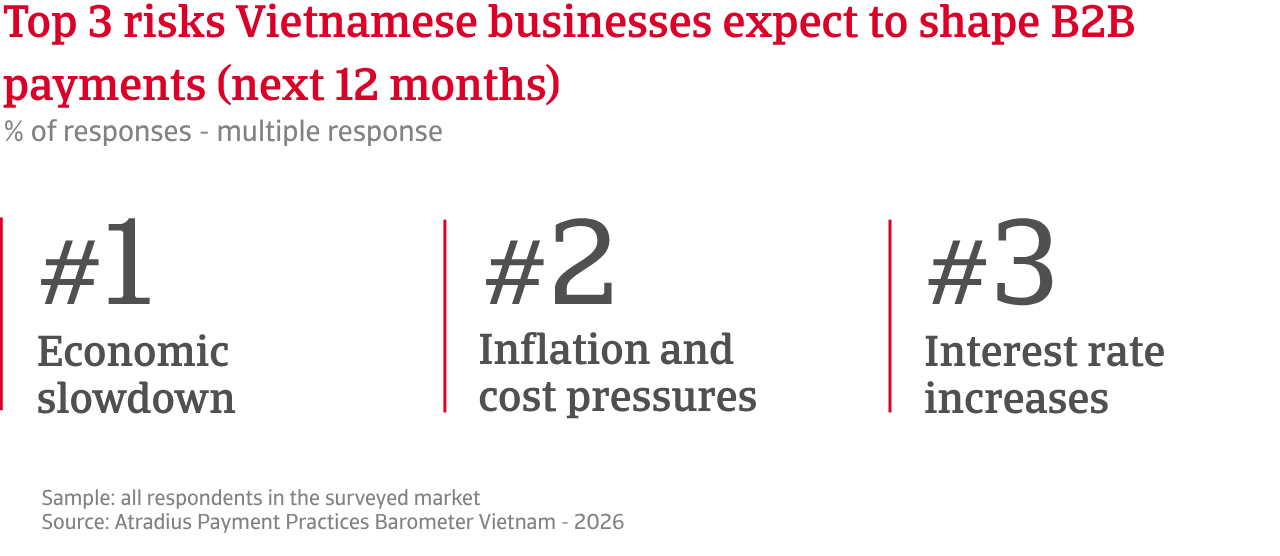
Businesses in Vietnam place greater emphasis on macroeconomic factors when assessing future B2B payment behaviour than their regional peers. Economic slowdown, interest rate increases, and supply chain disruptions are all cited more frequently than across Asia, highlighting the strong influence of external conditions on customer payment capacity. In contrast, operational risks are less often cited, suggesting that payment risk in Vietnam is driven less by internal processes and more by broader economic and trade disruptions. This outlook aligns with earlier findings. Vietnamese firms extend payment terms to sustain B2B trade and manage payment risk actively in response to liquidity pressures, even as they remain exposed to ongoing macroeconomic uncertainty.
For a full overview of the 2026 survey results for Vietnam, please download the market specific report from the related documents section below. Insights into Asia are available in the related content section below.
To explore how to strengthen your own credit risk strategy, get in touch with us and see how we can help you stay ahead.
