Atradius Atrium
直接访问您的保单信息、信用额度申请工具和洞察力。

 中国
中国
 阿联酋
阿联酋
 爱尔兰
爱尔兰
 奥地利
奥地利
 澳大利亚
澳大利亚
 巴西
巴西
 保加利亚
保加利亚
 比利时
比利时
 波兰
波兰
 丹麦
丹麦
 德国
德国
 法国
法国
 芬兰
芬兰
 荷兰
荷兰
 集团
集团
 加拿大
加拿大
 捷克共和国
捷克共和国
 立陶宛
立陶宛
 罗马尼亚
罗马尼亚
 美国
美国
 墨西哥
墨西哥
 挪威
挪威
 葡萄牙
葡萄牙
 日本
日本
 瑞典
瑞典
 瑞士
瑞士
 斯洛伐克
斯洛伐克
 斯洛文尼亚
斯洛文尼亚
 土耳其
土耳其
 西班牙
西班牙
 希腊
希腊
 香港SAR
香港SAR
 新加坡
新加坡
 新西兰
新西兰
 匈牙利
匈牙利
 意大利
意大利
 印度
印度
 英国
中国
英国
中国

From farming margins to supermarket shelves, the impact of the Gulf conflict can be felt throughout the food production chain. The closure of the Strait of Hormuz has led to rising energy and fertiliser prices, directly impacting global food production and prices. Higher fertiliser prices can already be seen in inflated food prices. In addition, rising energy costs are being felt in every step of food production, from planting and harvesting to processing, storage, and transport. This all has a direct impact on food producers, processors, retailers, and consumers alike.
Alongside the impact of the Gulf conflict, food production and prices are highly sensitive to adverse weather conditions, including heatwaves, droughts, and El Niño events. This summer's extreme temperatures are expected to reduce crop yields and agricultural output across the US and Europe. By early June, more than half of the US was experiencing drought conditions, affecting around 250 million acres of farmland. In Western Europe, prolonged heat and drought could increase food price inflation by more than one percentage point next year, potentially reaching 3%. A strong El Niño can further disrupt global agricultural trade by reducing harvests and tightening food supplies. These supply constraints can drive food prices higher, with Pacific-facing and agriculture-dependent economies often among the most affected.
Another downside risk is the escalating conflict in Ukraine. Attacks on ports, loading terminals, and vessels have disrupted grain exports from the region, reducing trade volumes. At the same time, strikes on Russian refineries and export infrastructure are pushing up global prices for petroleum products and fertilisers, increasing the likelihood of indirect pressure on food costs worldwide.
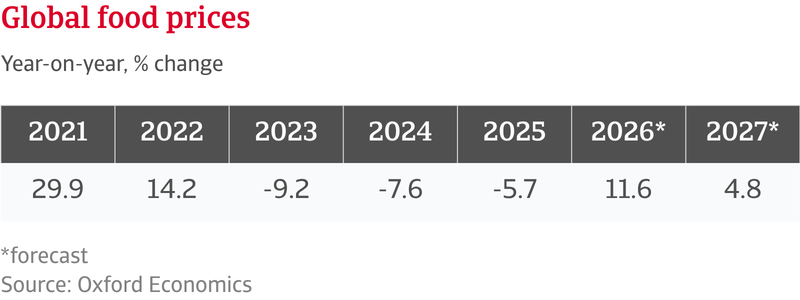
The combination of geopolitical and climate pressures is likely to constrain production in several key agricultural regions, increase global price volatility, and push food prices higher worldwide. Global food prices are forecast to increase by 11.6% in 2026 and by 4.8% in 2027.
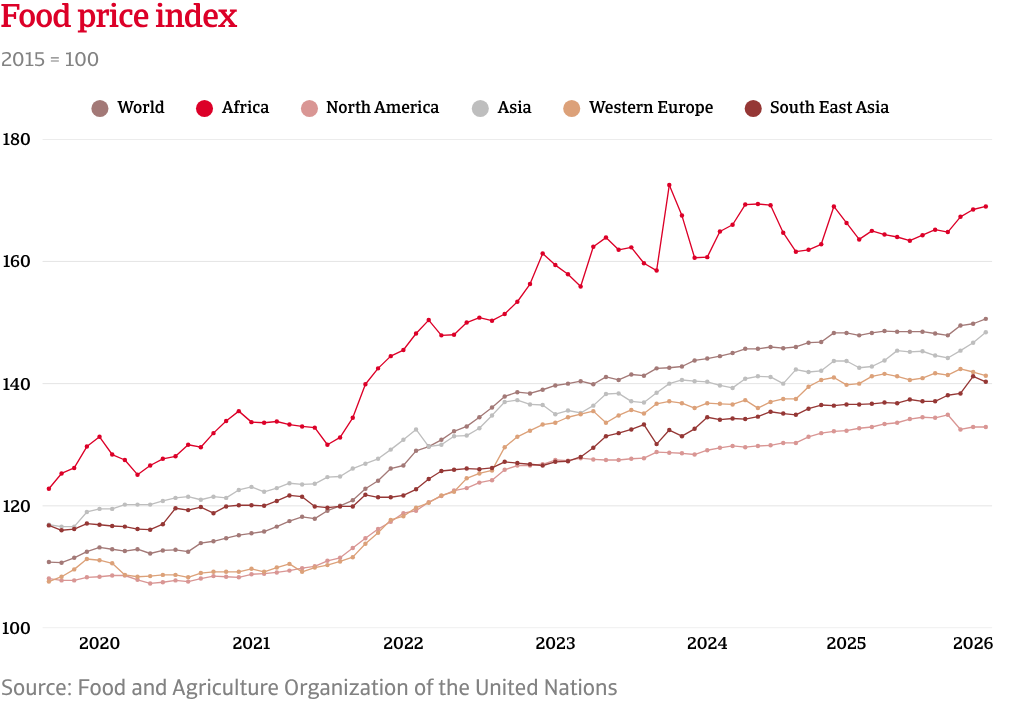
Emerging markets are expected to be more affected than advanced economies, given their higher weight in consumption baskets. In economies such as the Philippines, Indonesia, and India, food accounts for up to 40% of the consumer price index, versus around 10% in advanced economies, amplifying the effect on headline inflation.
.2026-08-31-11-50-26.png)
Higher input prices and food inflation, lower disposable household incomes due to higher energy prices and disruptions to food security are reshaping consumer eating habits and industry dynamics. For households, the impact of higher energy and food prices is felt through higher grocery bills and reduced purchasing power.
In the following, our food sector experts for the US, Europe, and emerging Asia assess the impact of the current events on consumer behaviour, on food producers and retailers and on the food premium segment and take a specific look at the credit risk situation of certain segments.
Rising energy and food prices are reinforcing consumer price sensitivity. Households are increasingly trading down to more affordable food brands, seeking promotions and prioritising value-for-money purchases and essential groceries. In advanced markets, private label brands have continued to gain market share as consumers focus on essential spending and reduce discretionary expenditures such as restaurant dining and premium food purchases. Shoppers are actively comparing prices, purchasing on promotion, and switching brands when price differences become meaningful.
As Sharon Benfer, Atradius Senior Underwriter in Baltimore, USA noted: “This is accelerating a trend we were already seeing. Even before the current price spikes, US and European consumers have been more price-sensitive on food items. This reflects ‘pricing fatigue,’ as prices remain structurally higher than pre-pandemic levels, despite food prices coming down recently.” In both Europe and the US, discounters are therefore gaining additional share, supported by sustained demand for affordability.
Even before the current price spikes, US and European consumers have been more price-sensitive on food items
In Southeast Asia, consumers are demonstrating similar behaviour, turning to cheaper brands, reducing their discretionary purchases and prioritising essential groceries. Sherly Caroline, Atradius Risk Underwriter in Jakarta, Indonesia, said: “Consumers in the region spend approximately 20% to 35% of their household expenditure on food, compared with 10% in the US and 13% in the EU. But lowest-income households may allocate as much as 60–70% of their income to food.”
As food prices increase, those consumers cannot reduce consumption significantly. There is a reallocation of consumption toward necessities, which prioritise staples over discretionary consumption. For example, rice or wheat are being prioritised over more expensive proteins like meats and fish.
Compared with developed markets, private-label products remain less established in emerging economies. In response to inflationary pressures, consumers tend to adapt quickly by purchasing smaller pack sizes, trading down to more affordable alternatives, taking greater advantage of promotions, and increasing their purchases through traditional retail channels.
.2026-08-31-11-49-27.png)
Across advanced and emerging markets alike, food producers and processors are facing higher input costs, in particular for energy, commodities, packaging, and transport. Profit margins for many businesses in this segment are structurally thin and had already been under pressure before the outbreak of the Gulf conflict. Further upward pressure on input costs has increased risks to profitability across the food value chain, although the impact is being felt differently across different regions.
In Europe, higher energy prices have a particularly negative impact on energy-intensive food production, especially those that use energy for cooling, heating, and processing. These are compounding existing challenges, such as elevated labour costs and regulatory burdens, including the stricter EU sustainability standards. As a result, already thin margins are further compressed. What’s more, limited pricing powers make it difficult to fully pass on rising input costs, especially in a highly competitive retail environment dominated by large players.
As a consequence, many European food producers are focusing on cost control, portfolio optimisation, efficiency improvements, and selective price increases in order to protect profitability. However, the gap between input cost increases and achievable pricing persists. Credit risk is higher for smaller or less diversified businesses with weaker bargaining power and for energy-intensive subsectors relying heavily on heating or cooling, transport, and feed costs, such as dairy and meat processing.
In Southeast Asia, producers are also struggling to pass higher costs on to retailers, because the grocery retail market is heavily consolidated. A handful of massive supermarket chains dominate and often have immense buying power, giving them enhanced ability to reject cost increases from food processors. In addition, consumer resistance to higher prices is high, as real incomes are under severe pressure. Sherly Caroline cautioned: “There is an elevated default risk for small and mid-sized food processors, struggling with margin compression and higher working capital requirements due to elevated input prices.”
In Southeast Asia there is an elevated default risk for small and mid-sized food processors
In the US, food producers and processors are currently also affected by higher input costs and face structurally thin margins. However, in contrast with Europe and Southeast Asia, we expect more US businesses to pass on price increases to consumers. This is because many producers and processors will not be able to absorb the increased costs.
.2026-08-28-10-03-20.jpg)
For some time now competition in the food retail subsector has increasingly focused on price. This has been evident in all three regions and is likely to continue, creating additional margin pressure for businesses. The food retail markets are characterised by a fiercely competitive environment, in which the bargaining power of major retailers and discounters is strong. Price wars will continue as food retailers compete for price-sensitive customers. Retailers are constrained in their ability to pass on higher costs, as they must keep prices low to retain increasingly price-sensitive consumers, resulting in sustained margin pressure. This pressure is exacerbated by the fact that energy, labour, logistics, and supplier costs have increased.
Sharon Benfer noted: “Larger US retailers may be better positioned to withstand margin pressure as they have greater capacity to absorb margin compression, higher bargaining power, and more access to financing and scale efficiencies.” But there is a negative impact on the credit risk situation of smaller food retailers, which have less capacity to absorb rising costs or compete aggressively on price.
Larger retailers may be better positioned to withstand margin pressure
In Southeast Asia, independent and small-scale food retailers are more vulnerable due to limited bargaining power against suppliers and restrained capability to compete effectively with large retailers on pricing or promotions. Many businesses are caught in a cash flow mismatch where they are paying suppliers quickly for expensive inventory while waiting longer to recoup cash from cash-strapped consumers. This rapidly escalates their probability of default on local business loans. Import-dependent food distributors and traders are vulnerable to higher global food prices and exchange rate volatility, as well as disruptions to freight and shipping.
In Europe, vulnerability is highest where cost inflation meets weak pricing flexibility. Leveraged small retailers will suffer more in contrast to larger, diversified producers and major retailers or discounters with greater scale, pricing power, and cost absorption capacity. Aurora Zubillaga, Senior Analyst Large Buyer Unit at Atradius CyC, Madrid, Spain, said: “In the EU, traditional mid-tier supermarkets face the greatest pressure, caught between the price leadership of discounters and the differentiation of premium retailers.”
In the EU, traditional mid-tier supermarkets face the greatest pressure, caught between discounters and premium players
In order to strengthen their resilience, many retailers are expanding private label ranges, optimising sourcing strategies, and investing in efficiency measures such as automation and AI to protect margins. Consolidation and clear differentiation are becoming essential.
.2026-08-28-12-17-33.jpg)
Premium, organic, and artisanal products have become increasingly popular in Western Europe and the US, due to a shift towards health-conscious and sustainable food options. In emerging Asia the expansion of premium, organic, and artisanal food has been driven by a fast-growing middle class, which consists largely of aspirational buyers rather than the ultra-wealthy.
However, the surge in energy and food price inflation is also presenting downside risks to the premium food segment. Producers and retailers in this segment have come under additional pressure, with higher credit risk expected for smaller businesses. In Europe the current inflationary environment is creating a more bifurcated demand pattern. While higher-income consumers still support parts of the premium segment, particularly in health and wellness, falling purchasing power overall is pushing many households to prioritise affordability. As a result, trading down and reduced consumption frequency are becoming widespread, especially in discretionary and mid-tier categories.
Many premium food retailers face volume pressure where price gaps versus private label are widening, while producers often operate with higher cost structures, increasing exposure to input cost inflation and limiting pricing flexibility. As Aurora Zubillaga noted for the premium food segment in Europe: “Overall, premium food remains structurally attractive in the long term but is cyclically vulnerable in the current low real-income environment, with margin pressure and risk particularly elevated for smaller or niche players.” Premium retailers are showing resilience but are dependent on affluent consumers.
Premium food remains structurally attractive in the long term but is cyclically vulnerable in the current low real-income environment
In Southeast Asia higher food and energy prices are reducing household purchasing power and driving a shift toward value-oriented consumption. However, the impact is not uniform. Sherly Caroline explained: “Demand from higher-income consumers may remain relatively resilient, and some premium brands with strong brand equity, differentiated products, and a loyal customer base may retain pricing power.” Nevertheless, smaller and less established players in this segment are likely to be more vulnerable in the current environment, in particular as energy, sourcing, and logistics costs are rising. Companies focused on essential food products, well-established mass-market brands, and locally sourced supply chains are generally better placed to navigate sustained inflationary pressures. In contrast, producers of premium discretionary food items, businesses that rely heavily on imported inputs, and brands with weaker competitive positions may face greater pressure on earnings and margins as consumers become more price conscious.
In recent years food companies have used mergers and acquisitions (M&A) to promote growth amid slower demand, margin pressure and weaker organic growth. In the US, we expect an acceleration of M&A activities due to the difficult market conditions. Larger companies will focus on certain core categories and divest themselves of those categories that are not value added. Private equity will continue to invest in those smaller companies that are unable to handle the margin pressures.
M&A activity in the European food sector is recovering in 2026 after a weaker 2025. The strategic rationale, this being the scale, efficiency, and portfolio reshaping, remains strong in a low-growth, high-cost environment. Margin pressures and competition are pushing companies to use M&A to gain scale, reduce costs, and strengthen supply chains.
In Europe, M&A activity is expected to increase most significantly in the retail sector, particularly among discounters, and in food processing, notably among mid-sized companies, with consolidation acting as the main driver. Selective acquisitions are also expected in resilient, health-focused, and high-growth segments, such as protein and functional foods. However, increased market uncertainty and higher financing costs could slow or postpone some transactions, particularly among smaller or more highly leveraged companies. Meanwhile, M&A activity may remain more limited in premium-oriented, artisanal, and niche brands, as these segments are more exposed to weaker consumer demand and valuation pressures.
To explore how to strengthen your own credit risk strategy, get in touch with us and see how we can help you stay ahead.


